
Property ownership types in Syria: green tabu, cooperative assignment, court ruling
The ownership line is the most consequential line in any Syrian listing, and the one buyers most often skip. It affects the price, your ability to resell, and occasionally whether you own the property at all.
Every Syrian listing carries a field for ownership type. Most buyers glance past it toward price, size and finishing. In practice that field decides whether you are buying a property or a problem.
- The land registry — the tabu — is the only official proof of ownership in Syria.
- Anything not recorded there in your name is an incomplete right, whatever paperwork you hold.
- Price reflects title. The cheaper property with identical specifications usually has weaker title, not a better deal.
1. Green tabu — full registered ownership
The “green tabu” is the title deed issued by the land registry, recording ownership formally in the holder’s name. It is the strongest form of ownership in Syria and the benchmark against which everything else is measured.
What it means in practice: you can sell, mortgage and bequeath without an intermediary, and transfer happens directly at the registry. Properties with green tabu are priced higher, sell faster, and are more widely accepted as security.
One distinction matters: partitioned green tabu means your share is defined and separated. Undivided (shared) tabu means you own an undivided share alongside others — which complicates selling and building, and requires the co-owners’ agreement.
Looking for property in Damascus? Tell us the area and budget — we search, view and verify the title deed on your behalf.
2. Cooperative assignment — a right ahead of title
This arises from housing cooperatives. The buyer holds a right to a dwelling within the cooperative, transferred by an assignment recorded with the cooperative rather than by a transfer at the land registry.
What it means in practice: you hold a contractual right against the cooperative, not a title deed. Conversion to green tabu happens later, once the cooperative completes its own process and all instalments are settled.
- Is the cooperative active and in good standing? What is its financial position?
- Are there arrears on the share, and who carries them after transfer?
- Is the assignment formally registered with the cooperative in your name, or is it a private paper between two parties?
- What is the realistic timeline to partition and title?
This category is not inherently bad — a good deal of quality Damascus stock began this way — but it demands deeper checking, and that should be reflected in the price you pay.
3. Court ruling
Here ownership rests on a final judicial ruling, typically following a dispute, an inheritance, or a sale contract that was never completed. The ruling can support registration, but actual registration at the land registry is what closes the loop.
What to confirm: that the judgment is final and no longer open to appeal, that appeal periods have expired, and that it has been — or can be — executed at the registry. A non-final judgment means unsettled ownership.
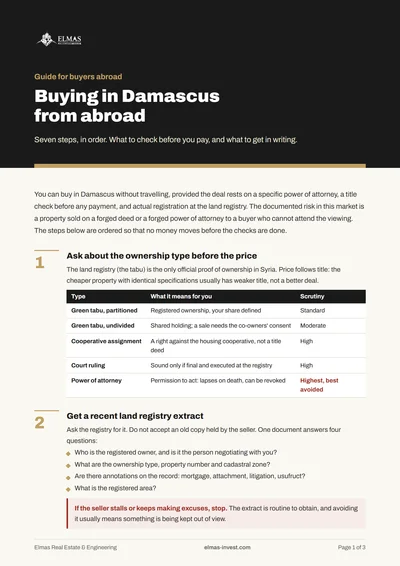
Seven steps in order, over three pages: what to check before you pay, what to get in writing, and the stop signs.
Looking for a specific property? Tell us the area and budget and we will search for you.
Request a property4. Sale by power of attorney — the riskiest
In this arrangement title never moves to you at all. The seller grants a power of attorney to deal with the property, and the property stays registered in their name.
The risks are well known: the power lapses on the grantor’s death, it can be revoked, and the property remains exposed to the seller’s debts and any attachments against them. The structure is sometimes used to move quickly or work around a constraint, but it transfers the entire risk to the buyer.
Our rule at Elmas is straightforward: a power of attorney is a temporary instrument for completing a step, not a permanent way to hold a property. If you must use one, put a firm deadline for transfer of title into the contract.
5. State land and agrarian reform land
Some properties sit on land with a special status — state property, agrarian reform land, or land inside a zoning scheme. These carry different rules of disposal and may not be freely sellable, or may be sellable only under conditions.
This cannot be assessed from a listing. It requires a registry search and a legal reading of the area’s planning status.
Comparing the types
| Type | Strength of title | Ease of resale | Checking required |
|---|---|---|---|
| Green tabu, partitioned | Highest | High | Standard |
| Green tabu, undivided | High | Moderate | Moderate — co-owner consent |
| Cooperative assignment | Moderate | Moderate | High |
| Court ruling | Depends on finality | Moderate | High |
| Power of attorney | Weakest | Low | Highest — best avoided |
In short
Ask about ownership type before you ask about price. Then request a recent land registry extract — not an old copy supplied by the seller. The difference between a sound purchase and an expensive one shows up on that document, not during the viewing.
We state ownership type explicitly in every listing, because we regard it as part of the price rather than a footnote. For the practical verification steps, see our due diligence guide.
This is general information to orient you, not legal advice. Property situations in Syria vary considerably by area, history and planning status — consult a property lawyer before signing anything.
Did not find what you were looking for? Tell us the area and budget, and we will search, view and verify the deed for you.
Finding an apartment in Damascus just got easier — with Elmas
Four short steps. We only ask for your name and number.
Area You can pick more than one
Apartment details Optional — skip anything that does not matter
Approximate budget
How do we reach you?
We usually reply within one working hour. Your number is never shared.
We have your request.
Continue on WhatsAppWe state ownership type on every listing
Browse our Damascus properties with title, finishing and floor set out plainly — or ask us to find you a green-tabu property within your budget.