
Due diligence before buying property in Syria
Most losses in Syrian property are not caused by paying too much. They are caused by checking too little. This is the sequence we run before we list anything — use it before you pay a deposit.
“Due diligence” sounds legalistic. In practice it means one thing: verify everything you have been told, before you pay.
The working assumption should be that every statement from a seller is a claim until confirmed by an official source. That is not an accusation of bad faith — many sellers genuinely do not know the precise legal status of their own property.
1. The land registry extract — always first
Request a recent extract issued by the land registry, not an old copy held by the seller. This single document answers four critical questions at once:
- Who is the registered owner — and is that the person negotiating with you?
- What is the ownership type, property number and cadastral zone?
- Are there annotations on the record — mortgage, attachment, litigation, usufruct?
- What is the registered area?
If a seller stalls on producing a recent extract or offers repeated excuses, stop. It is a routine document to obtain — avoidance usually means something is being kept out of view.
Looking for property in Damascus? Tell us the area and budget — we search, view and verify the title deed on your behalf.
2. Does reality match the register?
Do not assume what you see is what you will own. Check:
- Area: does the registered area match what has been built? Unlicensed extensions are not registered and can be removed.
- Boundaries: do the boundaries on the ground match the plan?
- Floor and unit number: a small detail and a recurring source of disputes.
- Shared elements: what is actually included — garage, roof, basement? It must be stated explicitly.
3. The area’s zoning status
Widely overlooked and highly consequential. Ask whether the property falls inside a zoning scheme, a development area, or an expropriation zone.
Areas brought into development schemes have seen demolition, expropriation and compensation that remains contested. Being inside a development area does not automatically make a property bad — but it changes what you are buying and what rights attach to it, and it must be known before purchase rather than after.
4. The seller’s legal standing
- Is the seller the registered owner, or an attorney? If an attorney: obtain the power of attorney, confirm it is in force and check the scope of authority, and that it has not been revoked.
- Are there heirs or co-owners holding undivided shares? Selling a share without the co-owners’ agreement invites dispute.
- Is the seller married, with rights attaching for a spouse?
- Does the seller carry debts that could result in attachments against the property?
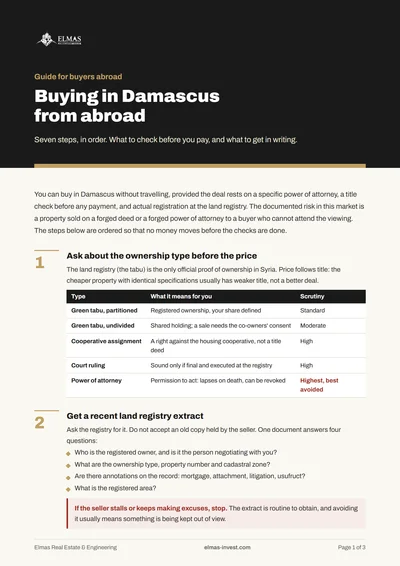
Seven steps in order, over three pages: what to check before you pay, what to get in writing, and the stop signs.
Looking for a specific property? Tell us the area and budget and we will search for you.
Request a property5. Financial clearance
Request clearance for fees and utilities: water, electricity, municipal charges, and cooperative dues where applicable. Arrears frequently pass to the buyer in practice, and can hold up transfer of title.
6. Structural survey
In a market containing buildings damaged during the conflict, a structural survey is not a luxury:
- Structural cracking in columns and beams — as distinct from surface cracks in paintwork.
- Drainage and damp, particularly on ground floors and in basements.
- Condition and capacity of the electrical installation.
- Roof condition and waterproofing.
- Lift and shared services.
If the building was damaged and repaired, ask what was repaired and by whom. A building in excellent cosmetic condition can be concealing a cosmetic repair to structural damage.
7. The contract itself
- A deadline for transfer of title at the land registry, with the final payment tied to it.
- The payment schedule — dates, amounts, currency. Not a verbal understanding.
- A seller’s warranty that the property is free of encumbrances, with liability for anything that later emerges.
- Exactly what the sale includes (garage, roof, shared shares).
- The handover date and the condition of the property at handover.
- Who bears the fees, taxes and registration costs.
The short checklist
| # | Check | Source |
|---|---|---|
| 1 | Recent land registry extract | Land registry |
| 2 | Free of annotations and attachments | Land registry |
| 3 | Area and boundaries match | Inspection + plan |
| 4 | Zoning status of the area | Municipality / planning |
| 5 | Seller’s capacity and power of attorney | Documents + notary |
| 6 | Clearance of fees and utilities | Utility providers |
| 7 | Structural survey | Independent engineer |
| 8 | Contract review | Property lawyer |
In short
Never skip items 1, 2 and 8, however much pressure there is to close quickly. Urgency is the most common instrument of pressure in questionable transactions — and any good property will survive an extra week of checking.
For which ownership types demand the deepest scrutiny, see ownership types in Syria.
A general checklist, not a substitute for legal and engineering advice on your specific case.
Did not find what you were looking for? Tell us the area and budget, and we will search, view and verify the deed for you.
Finding an apartment in Damascus just got easier — with Elmas
Four short steps. We only ask for your name and number.
Area You can pick more than one
Apartment details Optional — skip anything that does not matter
Approximate budget
How do we reach you?
We usually reply within one working hour. Your number is never shared.
We have your request.
Continue on WhatsAppWe check before we list
Every property in our portfolio is verified for title and zoning status before it reaches you — and we state the ownership type openly on each listing.