
Can foreigners buy property in Syria? The 2026 position
The short answer is yes, with conditions that depend on your nationality. The longer answer starts with a question most guides skip: are you actually a foreigner under Syrian law?
This is the most searched English question about Syrian property, and most of the answers online are wrong in the same way: they treat “foreigner” as though it means “anyone living outside Syria”. It does not.
So start here, because it changes everything that follows.
- If you hold Syrian nationality, you are not a foreigner. You buy as a Syrian, wherever you live.
- Non-Syrians can own property. The blanket prohibition people remember is not the current position.
- Arab League nationals generally may buy, subject to reciprocity.
- Non-Arab nationals face a longer approval route.
- A two-year restriction on disposing of the property applies after acquisition.
First: are you a foreigner under Syrian law?
Syrian nationality is what matters, not residence or where you pay tax. A Syrian who has lived in Berlin for twenty years and holds a Syrian passport buys property under the same rules as a Syrian in Damascus. Holding a second nationality alongside Syrian nationality does not move you into the foreigner category.
Where this genuinely bites is the second generation: children born abroad to Syrian parents who never registered their Syrian nationality. They are frequently treated as non-Syrian, and families discover it at the registry rather than beforehand.
If that describes anyone in your family, resolve the nationality question before you start a purchase, not during one. It is the single most common avoidable delay we see.
If you are Syrian and buying from abroad, the rules in this article do not restrict you and you should read our diaspora guide instead.
Looking for property in Damascus? Tell us the area and budget — we search, view and verify the title deed on your behalf.
The legal framework for non-Syrians
Ownership by non-Syrians is governed by Law No. 11 of 2011. The framework as it stands:
- Prior authorisation from the Ministry of Interior is required.
- An amendment removed the earlier requirement that ownership be for the benefit of a family rather than an individual, and removed the minimum property size that previously applied.
- Article 2 prohibits a non-Syrian from disposing of acquired property within two years without the Minister of Interior’s permission.
We should be straightforward about the status of that amendment: it was passed by Parliament and reported at the time as awaiting final signature and publication. Given everything that has happened in Syria since, confirm the operative text before you rely on it. Any guide that states these rules with total confidence is overstating what is publicly verifiable.
Arab nationals versus non-Arab nationals
| Arab League nationals | Non-Arab nationals | |
|---|---|---|
| General position | May purchase | May purchase |
| Main condition | Reciprocity with your country | Special approval |
| Approving body | Ministry of Interior | Ministry of Interior and Council of Ministers |
| Practical timeline | Shorter | Considerably longer |
Reciprocity is the concept doing most of the work here: the treatment your country extends to Syrians buying property there shapes the treatment you receive. It is assessed case by case, which is why nobody can give you a reliable yes or no by nationality alone in an article.
Inheritance
A separate and important change: non-Syrians may acquire Syrian real estate through inheritance with no minimum threshold, where this was previously restricted. The two-year restriction on disposing of the property still applies from acquisition.
This matters to a lot of mixed families — a non-Syrian spouse or a child who never held Syrian nationality inheriting a share of a Damascus apartment. The inheritance route has its own procedure, which we cover in our guide to inheritance certificates and transferring property to heirs.
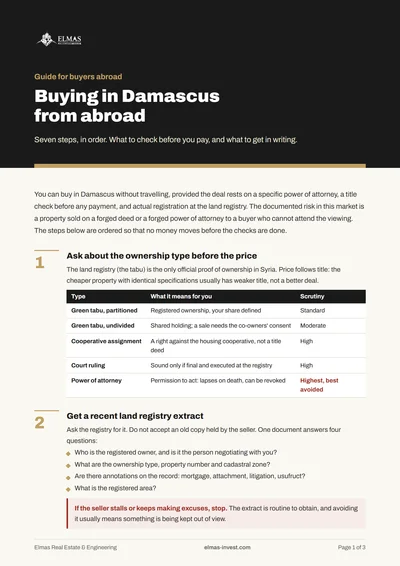
Seven steps in order, over three pages: what to check before you pay, what to get in writing, and the stop signs.
Looking for a specific property? Tell us the area and budget and we will search for you.
Request a propertyThe company route, and why we are cautious about it
In practice, some non-Arab investors buy through a Syrian-registered company or with a Syrian partner rather than in their own name. This is common enough that you will be offered it.
Be clear-eyed about what it involves. A company structure brings its own registration, tax and governance obligations, and holding property through a partner in whose name the asset sits is a genuine risk, not a technicality. We would not recommend either without proper legal advice specific to your situation — and we would treat anybody who presents it as a simple workaround with suspicion.
What the process looks like
- Confirm your status — Syrian national, Arab national, or non-Arab national.
- Verify the property: obtain a current land registry extract and confirm the seller is the registered owner. See due diligence before buying.
- Check the ownership type. Only fully registered title is straightforward — see ownership types in Syria.
- Apply for authorisation where required, before committing money.
- Contract and payment, with payments tied to procedural stages.
- Registration — ownership transfers on registration, not on payment.
Step 4 is the one people invert. Signing and paying first, then discovering the authorisation route is long or unavailable, is how money gets stuck.
Our honest advice
If you are a Syrian national, this article mostly does not apply to you and your route is considerably simpler. If you are not, the rules permit ownership but the process is administrative, discretionary in places, and slower than any brochure suggests. Budget time, get the authorisation position confirmed in writing before you commit, and use a lawyer who does this specific work.
Frequently asked questions
Can foreigners own property in Syria?
Yes. Non-Syrians may own real estate subject to authorisation from the Ministry of Interior. Arab League nationals are generally treated more favourably, subject to reciprocity, while non-Arab nationals face a longer approval route involving the Council of Ministers.
Do Syrians living abroad count as foreigners?
No. If you hold Syrian nationality you buy as a Syrian regardless of where you live or whether you hold another passport. The issue arises for children born abroad whose Syrian nationality was never registered.
Can a foreigner sell Syrian property immediately after buying?
No. Article 2 of Law No. 11 of 2011 prohibits a non-Syrian from disposing of acquired property within two years without permission from the Minister of Interior.
Can a non-Syrian inherit property in Syria?
Yes. Non-Syrians may acquire Syrian property through inheritance without a minimum threshold, though the restriction on disposing of it within two years of acquisition still applies.
- Based on Law No. 11 of 2011 and reported amendments to it, and on the UNCTAD Investment Policy Monitor entry regarding acquisition by non-Syrians through inheritance.
- The status of the reported amendment removing the family and minimum-size requirements should be confirmed against the operative text before you rely on it.
- This article is general guidance, not legal advice. Reciprocity and authorisation are assessed case by case — consult a Syrian lawyer for your specific nationality and circumstances.
Did not find what you were looking for? Tell us the area and budget, and we will search, view and verify the deed for you.
Finding an apartment in Damascus just got easier — with Elmas
Four short steps. We only ask for your name and number.
Area You can pick more than one
Apartment details Optional — skip anything that does not matter
Approximate budget
How do we reach you?
We usually reply within one working hour. Your number is never shared.
We have your request.
Continue on WhatsAppNot sure which category you fall into?
Tell us your nationality and what you are trying to buy, and we will tell you plainly which route applies and what it involves — before you spend anything on fees.