
Six questions to ask before buying an investment property in Syria
The fundamentals that decide whether a property is an investment or a trapped asset — applied to a market where two of them are genuinely difficult.
These six questions apply to property anywhere. What makes them worth restating for Syria is that two of them — exit and legal protection — are considerably harder to answer here than in most markets, and they are the two most often skipped.
1. Can you exit easily?
An asset you cannot sell when you need to is not liquid, whatever it is worth on paper. Syrian transaction volumes have been weak even while prices rose, which means selling can take a long time and often at a discount to the asking price you had in mind.
Before buying, ask: who is the likely buyer when I sell, and how long did comparable properties in this district take to move? Fully registered title in a sought-after area sells; an unusual property with a complicated ownership history may not sell at all at a sensible price.
Looking for property in Damascus? Tell us the area and budget — we search, view and verify the title deed on your behalf.
2. What is the real return?
Calculate the yield after everything: transfer costs on acquisition, maintenance, periods without a tenant, management, and the eventual costs of selling. Compare that against the gross rental figure you were quoted and the difference is usually substantial.
Note also that residential rental income tax for Syrian landlords was reportedly removed in recent reforms, which changes the arithmetic — confirm the current position before relying on it.
3. What is the location risk?
Location risk in Syria is not only about desirability. It includes service provision, the zoning position, whether the area falls within a regulated development zone with unresolved rights, and how the district came through the conflict. Two streets can differ sharply on all four.
4. How strong is the legal protection?
This is the question that most distinguishes Syria from a mature market. The protection you have depends almost entirely on the ownership type you buy into — see ownership types in Syria. Registered title is protected; a cooperative assignment or a property traded on a power of attorney is a weaker position, and priced accordingly for good reason.
Do not treat a discount on a weaker title as a bargain. It is the market pricing risk correctly.
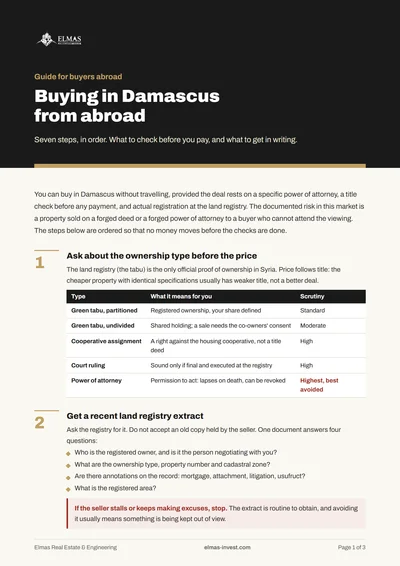
Seven steps in order, over three pages: what to check before you pay, what to get in writing, and the stop signs.
Looking for a specific property? Tell us the area and budget and we will search for you.
Request a property5. Is there effective management available?
If you live abroad, this determines whether the investment is workable at all. Who collects rent, handles repairs, deals with a tenant who stops paying, and checks the property is still occupied by who you think? An unmanaged property held remotely tends to deteriorate in both condition and value.
6. Does value appreciate over time?
Distinguish nominal appreciation from real appreciation. Prices rising in a depreciating currency is not the same as gaining value, and much of the reported rise in Syrian property prices reflects currency movement and scarcity rather than genuine growth in worth.
The dollar price in the district you are considering, compared over time, is the more honest measure.
A note on volatility
In an unsettled market, the discipline that matters most is refusing to let a good price override a weak answer to questions one and four. A cheap property you cannot sell and do not securely own is not cheap.
The market context is in Damascus property prices in 2026, and the verification steps in due diligence before buying.
Frequently asked questions
Is property in Syria a good investment in 2026?
It depends entirely on the specific property and how you answer the exit and legal-protection questions. Prices sit well below pre-conflict peaks, which is the case for buying, but liquidity is weak and title quality varies enormously.
What rental yield can I expect?
Calculate it net of acquisition costs, maintenance, vacancy, management and eventual selling costs rather than from the gross rent quoted. The net figure is usually considerably lower than the headline.
What is the biggest risk?
Buying into a weak ownership type because the price looked attractive, and then being unable to sell or to defend the title. The discount on weaker title reflects real risk rather than an opportunity.
- General guidance based on our practice in the Damascus market. Not investment, tax or legal advice.
- Tax treatment referred to here should be confirmed against the current position before you rely on it.
Did not find what you were looking for? Tell us the area and budget, and we will search, view and verify the deed for you.
Finding an apartment in Damascus just got easier — with Elmas
Four short steps. We only ask for your name and number.
Area You can pick more than one
Apartment details Optional — skip anything that does not matter
Approximate budget
How do we reach you?
We usually reply within one working hour. Your number is never shared.
We have your request.
Continue on WhatsAppWeighing up an investment purchase?
We give an honest read on liquidity, realistic yield and the risks specific to the district you are considering — including when our answer is not to buy.