
How to pay for a property in Syria from abroad
Finding the apartment is rarely the hard part. Moving the money is. Here is how to arrange payment before you sign, what the law requires, and how to document it so you can prove you paid.
Among buyers living in Germany, Sweden, the Gulf, Canada and the US, the obstacle is almost never the property. It is getting the money there — and it usually gets left until last, which is exactly when it becomes a problem.
Arrange this first. It determines your payment schedule, and your payment schedule is the main thing protecting you from four thousand kilometres away.
- Arrange the payment route before you sign, not after.
- An amount equal to 15% of the value must be settled through bank accounts.
- Tie every payment to a procedural stage, never a bare date.
- Keep proof of every transfer, matched to a signed receipt.
- Never hand over the full price before registration.
What has changed, and what has not
Restrictions on financial dealings with Syria have eased substantially over the past two years, and transfer channels have reopened accordingly. We covered that shift and its market effects in what sanctions relief means for Syrian real estate.
What has not changed is your own bank’s compliance posture. Easing at the policy level does not oblige a bank in Stockholm or Toronto to process a Syria-linked transfer, and many still apply their own internal rules, additional checks, or outright refusals.
So the practical first step is unglamorous: ask your own bank what it will and will not do, what documentation it wants, what its limits are, and how long it takes. Do this before you agree to a payment schedule in a contract. Do not assume.
Looking for property in Damascus? Tell us the area and budget — we search, view and verify the title deed on your behalf.
The 15% bank requirement
For sales of residential and commercial property and land, an amount equivalent to 15% of the approved value of the property unit must be settled through bank accounts.
For an overseas buyer this has a concrete consequence: you need a banking arrangement inside Syria and a slot for that transfer within your payment schedule. Discovering the requirement on registration day means postponing the transaction. The wider cost picture is in our guide to Syrian property transfer tax and fees.
Documenting payment — the part people skip
The biggest risk for an overseas buyer is not losing money in transit. It is being unable to prove you paid if a dispute arises later. So:
- Get a signed receipt for every payment, recorded on both copies of the contract.
- State the amount, currency, date, reason and the property reference on each receipt.
- Keep your own transfer confirmation and match it to the corresponding receipt.
- If an agent pays on your behalf, make sure the power of attorney says so explicitly.
Verbal understandings between relatives are what collapse most often. Document with family exactly as you would with a stranger — the paperwork costs nothing while everyone is still on good terms.
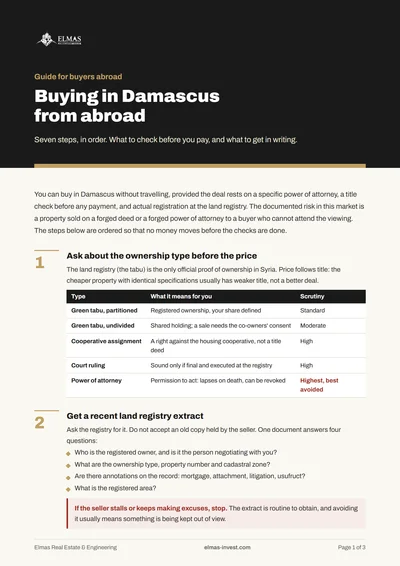
Seven steps in order, over three pages: what to check before you pay, what to get in writing, and the stop signs.
Looking for a specific property? Tell us the area and budget and we will search for you.
Request a propertyTie payments to stages, not dates
- A payment on signing.
- A payment after the registry entry is verified and any protective annotation is recorded.
- A payment at the financial directorate stage.
- The final payment on registration and handover.
The advantage for someone abroad is that any hold-up automatically stops the money. You never end up having paid in full while distant and without leverage.
Currency: put it in writing
Property in Damascus is quoted in dollars in most transactions, while payment or registration may involve Syrian pounds — and the new pound entered circulation at the start of 2026, removing two zeros. State the currency, and the exchange-rate reference and its date, for every instalment. A contract naming an amount without naming its currency is a dispute waiting to happen.
Before your first transfer
- Obtain a current land registry extract and confirm the seller is the registered owner.
- Ask your bank about its process, limits and timelines.
- Agree the currency and rate reference in writing.
- Fix in the contract who pays tax and fees.
- Allow a realistic gap between transfer and the payment due date.
The power of attorney also needs to grant payment and receipt authority explicitly — general wording gets rejected. See buying property in Syria from abroad.
Frequently asked questions
Can I send money to Syria legally?
Restrictions have eased substantially, but the decisive factor in practice is your own bank’s compliance policy in your country of residence. Ask your bank directly what it permits, what documentation it requires and how long transfers take before committing to a payment schedule.
What is the 15% bank settlement requirement?
For sales of residential and commercial property and land, an amount equal to 15% of the approved value of the unit must be settled through bank accounts. Plan this transfer into your payment schedule rather than discovering it at registration.
What is the biggest risk when paying from abroad?
Being unable to prove payment if a dispute arises, and paying in full before registration. Protect yourself by documenting every payment on both copies of the contract and tying instalments to procedural stages.
- This article is general guidance. It is not financial, banking or legal advice, and it does not recommend any particular transfer provider.
- Transfer procedures and compliance policies vary by country and by bank — check with yours directly.
- Sanctions frameworks change; confirm the current position before transferring funds.
Did not find what you were looking for? Tell us the area and budget, and we will search, view and verify the deed for you.
Finding an apartment in Damascus just got easier — with Elmas
Four short steps. We only ask for your name and number.
Area You can pick more than one
Apartment details Optional — skip anything that does not matter
Approximate budget
How do we reach you?
We usually reply within one working hour. Your number is never shared.
We have your request.
Continue on WhatsAppBuying from abroad and want the payment sequence set up properly?
We work with buyers outside Syria to tie each payment to a documented stage of the transaction. Talk to us before you transfer anything.