
Syria’s Two-Million-Home Plan to 2035: What It Means for Property Buyers
The Ministry of Public Works and Housing puts the deficit at about 1.9 million units, and a plan running to 2035 aims to build or rehabilitate two million homes. We separate the official numbers from what can be bought today.
The question reaches us in two forms: will Syria’s two-million-home plan push property prices down, and should I wait to buy a cheap government apartment? The plan is large, but its horizon is 2035, and most of its tracks have not started in practice. We set out what the official sources say, then separate the plan’s numbers from what can actually be bought today.
The deficit that explains the plan
Syria’s Ministry of Public Works and Housing estimates the housing deficit at about 1.9 million units in 2025, and warns it could widen to about 2.5 million units by 2030 if construction does not accelerate. That estimate appeared in a report published by International Finance on 28 Sep 2026, which names assistant minister Imad al-Masri.
Against that, the plan targets building or rehabilitating about two million homes by 2035, cutting the deficit by more than 70%. The two figures together explain the nature of the plan: it is a response to a real shortage, not a programme to lower prices.
What this means for you: the size of the deficit is why the plan exists, not proof that it will produce discounted housing. If you are looking in Damascus or Aleppo, the useful question is what exists today, not what may exist ten years out. If your timeline is nearer, send us your area and budget and we work the market that exists now through our property request.
Looking for property in Damascus? Tell us the area and budget — we search, view and verify the title deed on your behalf.
Four delivery tracks
Delivery rests, per the same International Finance report, on four distinct tracks:
| Track | What it means |
|---|---|
| Completing existing and stalled housing projects | Restarting buildings that were begun and stopped |
| Repairing homes that can be rehabilitated | Fixing part of the existing stock |
| Rebuilding destroyed or badly damaged properties | Replacing what was demolished or heavily damaged |
| Adding new housing according to demand in individual governorates | New building that follows each governorate’s need |
The first three tracks work on what already exists; the fourth adds new supply. That split matters for anyone reading the headline: a meaningful share of the two million homes is completion and repair rather than new construction. It is wrong to read the figure as a full wave of new housing arriving in a single year. And the new housing itself follows demand in each governorate, so it moves where demand is highest, not only where a buyer wants a lower price.
Who pays: the state brings land, investors bring capital
The government is seeking private and foreign capital. Per International Finance, one proposed model has the state provide land owned by the General Housing Establishment, while private investors finance and develop the housing.
What this means for you: delivery depends, to a large degree, on that capital actually arriving. And when delivery is in private hands, part of the resulting stock will be offered at market prices rather than subsidised prices. That is a substantial gap between the promise of the plan and its practical outcome.
What reconstruction costs
The World Bank estimated in 2025 that rebuilding Syria’s physical assets would cost about US$216 billion, split as follows:
| Sector | Estimated cost |
|---|---|
| Residential buildings | About US$75 billion |
| Infrastructure | About US$82 billion |
| Non-residential structures | About US$59 billion |
| Total | About US$216 billion |
Sources: International Finance and Finance Middle East. The number makes the scale of the plan clearer: its cost is not measured in homes alone, but in the infrastructure and services each unit needs to become liveable. Residential buildings are roughly a third of the total, a point worth noting for anyone who assumes the funding goes straight into apartments.
In the same context, the IMF expects double-digit growth in 2026, but warns that poverty remains widespread and that the banking sector needs reform. Housing demand is most acute in Damascus and Aleppo, per the two outlets cited.
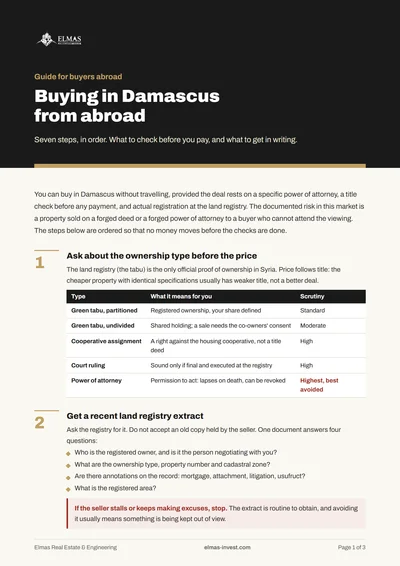
Seven steps in order, over three pages: what to check before you pay, what to get in writing, and the stop signs.
Looking for a specific property? Tell us the area and budget and we will search for you.
Request a propertyWhy this does not mean cheap apartments today
Three things stand between the headline and the price of the apartment you buy:
- Time. The target year is 2035, and any new supply arrives in stages, not at once.
- The nature of the tracks. A share of the numbers is completion and repair of existing stock, not extra building that immediately pressures the market.
- Funding. Private and foreign capital arriving is a condition of delivery, not a known outcome in advance.
And any increase in supply does not on its own set the direction of prices. Demand, cost, existing stock and market confidence all move together. So we give no figure for price direction, and we promise no government home on a known date. Anyone building a decision on waiting for a subsidised home they may not qualify for is postponing a year they may need.
What you can actually buy now
The market you can work with today is the existing one: ready or under-construction apartments in Damascus and its countryside, with prices that follow local demand. To build a realistic picture, start from a comparison of districts in our guides to reconstruction in 2026 and moving back to Syria. Both frame the current market, not the 2035 plan.
We hold no property inventory. Our work is to take the client’s area, budget and specification, then search for the right property and stand with them through viewing, negotiation and document checks. That is what it means to have someone on the ground in Damascus while you are abroad.
The bottom line: separate the policy from the market
The two-million-home plan to 2035 is a response to a real housing deficit, and it is worth following because it will gradually reshape the market. But it does not mean cheap apartments today, and it does not give you a confirmed date for a government home. If your plan is to be settled before this supply arrives, the sensible move is to work the market that exists now.
Common questions
Will property prices in Syria fall after the two-million-home plan?
The plan aims to build or rehabilitate homes over years to 2035, as a response to a housing deficit rather than a price-setting tool. It gives no figure for price direction, and the mix of tracks shows that part of it is completion and repair rather than new supply.
Will I get a cheap government apartment from the plan?
The plan runs on four tracks, some of which are completion and repair. The proposed model relies on private and foreign capital, so it is not a promise of a subsidised home for every applicant, nor a set price for any unit.
When do the homes start arriving?
The target year is 2035 and delivery is in stages. Per the sources, there is no confirmed delivery date for a specific home at this stage.
What is the cost of rebuilding Syria’s housing?
The World Bank estimated in 2025 that rebuilding physical assets would cost about US$216 billion, including about US$75 billion for residential buildings, US$82 billion for infrastructure and US$59 billion for non-residential structures.
Should I wait or buy now?
It depends on your own timeline. If you need housing before this supply arrives, the existing market is what is available, and we can search it according to your area and budget.
- International Finance: Syria plans two million homes by 2035 amid severe housing deficit – https://internationalfinance.com/real-estate/syria-plans-two-million-homes-by-2035-amid-severe-housing-deficit/
- Finance Middle East: Liquid capital: how Gulf states are making different bets on Syria’s reconstruction – https://www.financemiddleeast.com/analysis/liquid-capital-how-gulf-states-are-making-different-bets-on-syrias-reconstruction/
- General information, not legal or investment advice.
- The figures above are attributed to their sources, and the housing plan and its official numbers may change as the relevant bodies update them.
Did not find what you were looking for? Tell us the area and budget, and we will search, view and verify the deed for you.
Finding an apartment in Damascus just got easier — with Elmas
Four short steps. We only ask for your name and number.
Area You can pick more than one
Apartment details Optional — skip anything that does not matter
Approximate budget
How do we reach you?
We usually reply within one working hour. Your number is never shared.
We have your request.
Continue on WhatsAppPlanning to settle before this supply arrives?
If your plan is to be settled before this supply arrives, send us your area and budget, and we work the market that exists now.