
What sanctions relief means for Syrian real estate
The repeal of the Caesar Act’s secondary sanctions in December 2025 changed the rules for financing and transfers. But less changed than is often claimed, and what remains matters to anyone sending a purchase price into Syria.
Over the past two years the legal framework around financial dealings with Syria has shifted substantially. For anyone buying property — particularly from abroad — this is not a political headline but an operational detail affecting how you pay.
What actually happened
Relief arrived in stages rather than all at once:
| Date | Measure |
|---|---|
| January 2025 | General License 24 issued |
| May 2025 | General License 25, plus a 180-day suspension of the Caesar Act |
| June 2025 | Executive Order 14312 directing agencies to lift sanctions and export controls |
| November 2025 | Second 180-day suspension of the Caesar Act |
| December 2025 | Repeal of Caesar Act secondary sanctions within the FY2026 National Defense Authorization Act |
The most consequential effect is the reshaping of the framework governing non-US parties dealing with Syria. A bank in Türkiye, the Gulf or Europe that previously avoided any Syrian exposure for fear of secondary sanctions now has considerably less reason to.
Looking for property in Damascus? Tell us the area and budget — we search, view and verify the title deed on your behalf.
What changed for buyers
- Correspondent banking relationships are gradually being restored — the backbone of any international transfer.
- Remittances increasingly move through formal channels, and at lower cost than informal ones.
- Trade finance has partly returned, which feeds through to construction material imports and therefore build costs.
- Reconstruction investment is now legally possible for parties that previously abstained entirely.
What did not change
- Syria remains designated a State Sponsor of Terrorism.
- Specific individuals and entities remain sanctioned, including former president Bashar al-Assad, Captagon networks, and persons linked to ISIS and al-Qaeda.
- Banks continue to apply enhanced due diligence to any Syria-linked transfer.
- Sanctions relief does not relax anti-money-laundering obligations — if anything it raises scrutiny of source of funds.
Put differently: the door has opened, but the check at the door is more thorough. Anyone expecting to move a large sum without questions will be surprised.
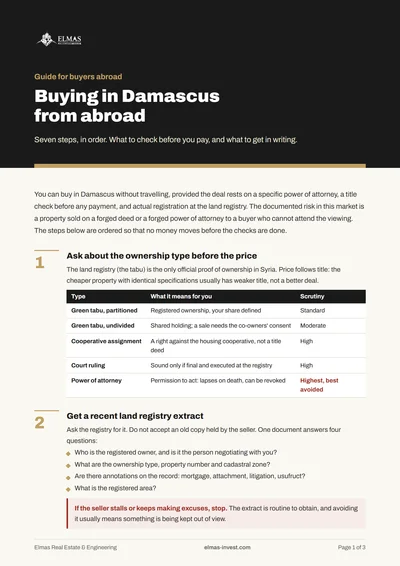
Seven steps in order, over three pages: what to check before you pay, what to get in writing, and the stop signs.
Looking for a specific property? Tell us the area and budget and we will search for you.
Request a propertyWhat it means for prices
The effect is indirect but real, working through three channels:
- Demand: easier transfers mean greater capacity among buyers abroad — and they buy in particular districts, concentrating demand there.
- Build costs: returning trade finance affects material prices, currently the primary driver of property prices.
- Expectations: talk of large reconstruction investment lifts prices before any capital actually lands.
Note though that these drivers raise prices without necessarily raising liquidity. That is exactly what we observe — prices climbing while transaction volume falls. More detail in Damascus property prices in 2026.
Practical steps before you transfer
- Speak to your bank first and ask directly about its policy on transfers to Syria.
- Document your source of funds — statements, employment contract, a prior sale agreement.
- Tie the transfer to a written contract identifying it as the price of a specific property.
- Avoid informal channels. They look faster, but they leave the payment without a documented trail — which obstructs registration and makes proof of payment difficult in any dispute.
- Check the counterparty — confirm the seller is not on any active sanctions list.
In short
Sanctions relief removed a significant obstacle for buyers abroad, but it did not remove the need for disciplined documentation — it increased it. The safest buyer today is the one whose purchase rests on complete paperwork and a formal transfer, not the fastest one.
For the full sequence from power of attorney to registration, see our guide for buyers abroad.
- Syrian Network for Human Rights — repeal of Caesar Act secondary sanctions, December 2025
- US National Defense Authorization Act, FY2026
- Office of Foreign Assets Control (OFAC) — Syria-related sanctions programs
A summary for orientation, not legal or financial advice. Sanctions regimes change — check with your bank and a legal adviser before transferring.
Did not find what you were looking for? Tell us the area and budget, and we will search, view and verify the deed for you.
Finding an apartment in Damascus just got easier — with Elmas
Four short steps. We only ask for your name and number.
Area You can pick more than one
Apartment details Optional — skip anything that does not matter
Approximate budget
How do we reach you?
We usually reply within one working hour. Your number is never shared.
We have your request.
Continue on WhatsAppPlanning to buy from abroad?
We help structure the purchase properly — from selecting the property through to registration at the land registry.