
Proving you own property in Syria when the documents are gone
Losing the deed is not losing the property. Here is what actually establishes ownership, what happens when a title has been forged, and which evidence the courts will look at.
A version of this question reaches us most weeks, usually from someone in Europe: “we have a house in Damascus, we do not have the papers, and we do not know if it is still ours.”
Start with the piece of reassurance that is genuinely true. The document in your drawer is not your ownership. Ownership is the entry in the land registry. Losing your copy does not cost you the property as long as the entry is intact. The real risk is not the missing paper — it is whether the entry itself was touched.
- The registry entry is the ownership; your paper copy only evidences it.
- First step, always: obtain a current land registry extract.
- If another name appears, the route is judicial, not administrative.
- Without a deed, courts consider registry copies, utility records, testimony.
- Specialised judicial departments have been designated for forged-title cases.
Step one: is the entry still in your name?
Before assuming anything, request a current land registry extract from the directorate covering the area where the property sits. It answers the only question that matters at this stage: who is the registered owner today, and are there annotations — mortgage, seizure, litigation — against the property.
Three outcomes:
- The entry is in your name and clean. This is administrative: request a replacement copy and the matter ends. A great many alarmed enquiries end right here.
- The entry is still in the deceased owner’s name. The property was never transferred to the heirs, and you need a transfer procedure — see inheritance certificates and transfer to heirs.
- The entry names someone you do not recognise. This is where it becomes a serious legal matter.
Looking for property in Damascus? Tell us the area and budget — we search, view and verify the title deed on your behalf.
When an unfamiliar name appears
Property typically leaves an absent owner’s name in one of three ways: a forged power of attorney executed in the owner’s name, a forged title document used in a transfer, or manipulation of the registry entry itself.
Investigative reporting has documented networks specialising in property-title forgery operating across several Syrian cities under the former government, and a Ministry of Justice source has indicated that thousands of properties had ownership falsified and were sold through illegitimate transactions.
What this means for you in practice: a sale founded on forgery does not create valid ownership. But undoing it runs through the courts and takes time. Time matters here — the longer it goes undetected, the more subsequent transactions accumulate on the property and the more tangled the position becomes.
What counts as evidence without a deed
- A copy of the registry entry — always the strongest, requested from the directorate directly.
- Utility accounts in your name, particularly electricity and water, since installing a meter nominally involves a municipal inspection, making them a useful indicator of possession.
- Earlier sale or tenancy contracts and any official correspondence concerning the property.
- Witness testimony and recognition of ownership by neighbours and the local community.
- Tax records and receipts for fees paid on the property.
We should be honest about the limits: in these cases courts rely substantially on non-documentary evidence, investigation and questioning, and that process does not guarantee a quick outcome. Anyone promising you a fast result is selling you something.
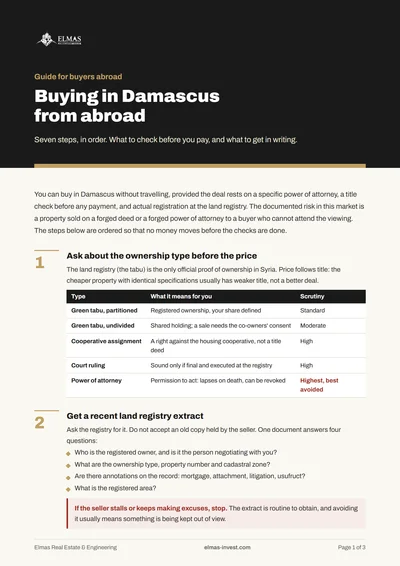
Seven steps in order, over three pages: what to check before you pay, what to get in writing, and the stop signs.
Looking for a specific property? Tell us the area and budget and we will search for you.
Request a propertyWhere the judicial process stands
Since December 2024, recovering forged titles has become a public policy question rather than a series of isolated disputes. The Ministry of Justice has indicated that specialised courts and judicial departments have been designated to handle forged-ownership cases, with the aim of speeding up rulings and unifying interpretation, and a specialised court has been described as planned during 2026 to examine forgery carried out under the former government.
Treat that as an announced direction rather than an instrument you can rely on. Confirm its actual status before filing.
Why this file moves slowly
For scale: Syria had roughly 5.5 million homes before 2011. An estimated 328,000 were completely destroyed, around one home in three sustained total or partial damage, and some 5.7 million people need direct housing support. A large share of Syrian housing was built outside the formal system to begin with.
This is not a backlog of individual disputes. It is a national file being worked through an entire court system, which is why patience is a description of reality rather than advice.
What to do now, in order
- Do not deal with the property or sign any power of attorney to sell before you know the registry position.
- Obtain the registry extract — yourself or through a trusted representative in Syria.
- Gather what you have: old papers, bills, photographs, correspondence, however marginal it seems.
- Record the current occupancy — who is in the property and on what basis.
- Consult a specialist property lawyer before filing anything. Framing the claim wrongly costs years.
If you are buying rather than recovering, read this from the other side: due diligence before buying property in Syria.
Frequently asked questions
I lost my title deed — have I lost the property?
No. Ownership rests on the land registry entry, not on your paper copy. If the entry is still in your name the matter is administrative and resolved by obtaining an extract and a replacement copy.
How can I check my property from outside Syria?
Authorise a trusted person or a lawyer in Syria to obtain a current land registry extract from the directorate covering the property’s area. This is the first step and should not be skipped.
My property was sold using a forged power of attorney. Is the sale valid?
A sale founded on forgery does not create valid ownership, but reversing it goes through the courts and requires evidence and time. Acting quickly matters, because further transactions on the property complicate the position.
- Information on forgery networks, housing damage and the move toward specialised courts draws on published investigations and reporting, including work by Daraj and SIRAJ and United Nations housing assessments.
- References to specialised courts rest on statements attributed to Ministry of Justice sources and are not a substitute for an operative instrument.
- This article is general guidance, not legal advice. Consult a specialist lawyer before filing a claim or dealing with the property.
Did not find what you were looking for? Tell us the area and budget, and we will search, view and verify the deed for you.
Finding an apartment in Damascus just got easier — with Elmas
Four short steps. We only ask for your name and number.
Area You can pick more than one
Apartment details Optional — skip anything that does not matter
Approximate budget
How do we reach you?
We usually reply within one working hour. Your number is never shared.
We have your request.
Continue on WhatsAppNeed someone to check a property on the ground in Damascus?
We obtain the land registry extract, establish the property’s actual status and who occupies it, and give you a clear picture before you take any legal step.