
Buying property in Syria from abroad: a 2026 guide
You can buy an apartment in Damascus without setting foot in Syria — provided the deal rests on a properly drawn power of attorney, a documented transfer, and actual registration at the land registry. Here are the steps, in order.
Almost everyone who contacts us from overseas opens with the same question: can I buy while I’m outside Syria? The answer is yes — millions of Syrians abroad own and manage property this way. But the method rewards discipline, because mistakes made at distance are harder and slower to correct.
Can Syrians abroad buy?
Yes. If you hold Syrian nationality your right to own stands as a citizen, whether you are resident or not, and whether or not you also hold another nationality. Private property rights are protected in law so long as the property was lawfully purchased and properly registered in your name.
Looking for property in Damascus? Tell us the area and budget — we search, view and verify the title deed on your behalf.
What about non-Syrians?
Different position. Non-Syrians are generally barred from owning land directly, with exceptions requiring specific approvals. A change now permits non-Syrians to acquire property through inheritance with no minimum threshold, where this was previously prohibited — subject to a restriction on disposing of the property within two years of acquisition.
In practice: if you are a foreign national married to a Syrian, or you have inherited property, a route exists — but it needs tailored legal advice before any payment.
Step 1: the power of attorney
The power of attorney carries the whole transaction. It is drawn at the Syrian embassy or consulate in your country of residence, then authenticated inside Syria to become effective.
- Specific, not general. Name the property and define the authority precisely rather than granting open powers.
- Choose the attorney carefully. A trusted relative or a lawyer — this person signs on your behalf.
- Put a time limit on it. An open-ended power is a risk you don’t need to carry.
- Check the listed powers: purchase, registration at the land registry, taking possession, paying fees.
Step 2: documents
- A valid passport and/or Syrian ID.
- A recent civil registry extract.
- The authenticated power of attorney.
- Evidence of source of funds — increasingly required as banking relationships resume.
A very common obstacle: missing civil documents. Around a quarter of returning refugees lack the basic papers needed to register children, reclaim property, or pursue legal remedies. If your documents are incomplete, start replacing them before you start looking at properties, not after you’ve agreed one.
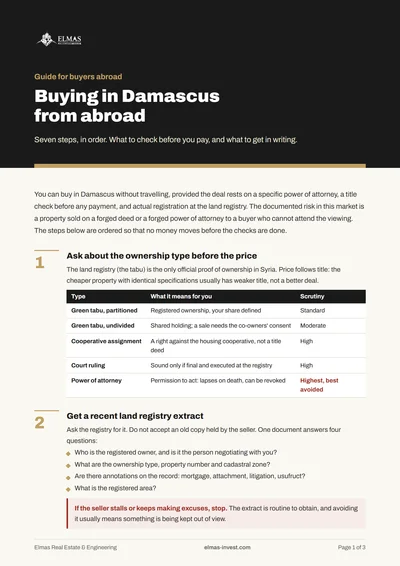
Seven steps in order, over three pages: what to check before you pay, what to get in writing, and the stop signs.
Looking for a specific property? Tell us the area and budget and we will search for you.
Request a propertyStep 3: transferring the money
This is where the landscape genuinely changed. Repeal of the Caesar Act’s secondary sanctions in December 2025 has begun to restore correspondent banking relationships, remittance flows and trade finance.
Syria remains designated a State Sponsor of Terrorism, and specific individuals and entities are still listed. Western banks continue to apply enhanced scrutiny to Syria-linked transfers.
In practice: speak to your bank before moving a large sum, keep source-of-funds documentation, and avoid informal channels to sidestep procedure — thin documentation obstructs registration later.
Step 4: verifying the property
Do not sign or transfer before confirming:
- A recent land registry extract showing the owner’s name and ownership type.
- The property is free of attachments, mortgages and litigation.
- The area and boundaries match both reality and the register.
- The property’s position in the zoning scheme — is it inside a development or expropriation area?
- Clearance of fees and utility arrears.
The full sequence is in our due diligence guide.
Step 5: registration — the step not to postpone
This is the most frequent error among buyers abroad: transfer the money, collect the sale papers, then leave registration until “the next visit”. Throughout that gap the property remains legally the seller’s, and exposed to their debts, heirs and disputes.
Make registration a contractual term with a defined deadline, and tie the final payment to it.
Step 6: managing it afterwards
If this is an investment rather than a home, decide in advance: who handles maintenance and bills, how rent is collected and remitted to you, and who represents you in a dispute. A written management arrangement from the outset saves a great deal later.
Common questions
How long does the whole process take?
It varies considerably with ownership type and how complete your documents are. Partitioned green tabu with full papers is fastest; assignments and court rulings take longer.
Do I need a lawyer?
For any serious purchase, yes. Legal fees are a small fraction of the purchase price and far smaller than the cost of a later dispute.
Can I buy in instalments from abroad?
In some development projects, yes. Ensure the payment schedule and transfer mechanism are written into the contract rather than agreed verbally.
- Repeal of Caesar Act secondary sanctions within the FY2026 NDAA — December 2025
- UNCTAD Investment Policy Monitor — acquisition of property by non-Syrians through inheritance
- Reporting on missing civil documentation among returnees — Daraj, Syria Report
General information, not legal advice. Rules change and circumstances differ — consult a property lawyer before signing or transferring.
Ready to look at specific projects? Both of these are bought off plan the way this guide describes: apartments in Marota City and Yaafour 963 in rural Damascus.
Did not find what you were looking for? Tell us the area and budget, and we will search, view and verify the deed for you.
Finding an apartment in Damascus just got easier — with Elmas
Four short steps. We only ask for your name and number.
Area You can pick more than one
Apartment details Optional — skip anything that does not matter
Approximate budget
How do we reach you?
We usually reply within one working hour. Your number is never shared.
We have your request.
Continue on WhatsAppBuying from outside Syria?
We work with buyers abroad at every stage: selecting the property, verifying title, and coordinating through to registration. Tell us where you are and what you’re looking for.